

Note: Some links in this post are affiliate links. If you purchase through them, I may receive a small commission at no additional cost to you. I only share resources I’ve personally used or fully stand behind. Your trust matters more to me than any commission.
Rapture questions people are afraid to ask out loud
I have taught about the rapture at many ministry events, and the pattern is always the same. The questions people ask during the session are the safe ones. The real questions come afterward, quietly, near the coffee table, usually prefaced with some version of “this is probably a dumb question, but…”
They are never dumb questions. They are the questions that keep people from studying this subject at all. So let me put five of them in writing, where nobody has to raise a hand.
“Will all Christians be taken?”
This one comes up very frequently. During Q&A sessions, or in personal conversations between messages or during lunch, someone nearly always asks a form of this question. Somewhere along the way, the rapture got taught as a performance review, and people started quietly wondering whether they would make the cut. This question actually ties back to a proper view of salvation itself. There are no super-Christians. The ground is level at the foot of the cross and we all desperately need our Savior.
Paul writes that the dead in Christ will rise first, and that we who are still alive will be caught up together with them. The dividing line is being in Christ, and it rests on what Jesus finished rather than on how well you have been doing lately. In 1 Corinthians 15:52-53 Paul states, “the dead will be raised imperishable, and we will be changed.” That “we” includes the entire Church. Every single believer alive at the time of the rapture will be caught up. If you are trusting Him, you are included. That is the entire basis, and it does not fluctuate with your week.
“Isn’t the rapture just the second coming?”
A lot of thoughtful believers hold that position, so this is a fair question rather than a naive one.
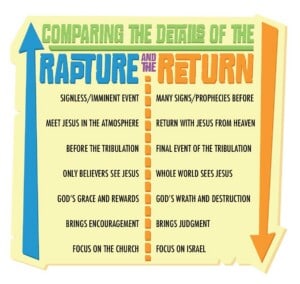
Here is what moved me. Read Matthew 24:30-31 (along with Revelation 19:11-21) and 1 Thessalonians 4:15-17 back to back and notice the details. In one, Christ comes to the earth for the purpose of judgment and stays. In the other, believers meet Him in the air and go to be with Him where He is. One is for judgment and preparing the earth for the Kingdom. The other is a rescue to go be with Him. Different destinations, different accompanying events, different details, different outcomes. The first coming of Jesus also arrived in two parts, roughly thirty years apart, and we celebrate them separately every year without thinking twice about it. The second coming has two parts for two purposes—both related to (and flanking) all key end-time events. The rapture and the return are book ends of all of the end-time events we read about in Revelation 6-18. The rapture is the domino that sets things in motion. The return is the event that ends the tribulation period.
“Didn’t somebody make this up in the 1830s?”
You will hear this one online constantly, usually stated with a great deal of confidence, and sounding quite academic. The problem, however, is that it is not true.
The formal, organized, academic version of the pretribulation position does come from the nineteenth century. But John Darby did not “invent” the doctrine, nor did he receive it from a demonically-possessed teenaged girl as is often the claim. Both of these details have been thoroughly and repeatedly debunked, yet this lie continues to be told. Furthermore, the basic understanding and framework for the pre-trib position goes back to the first century. For example, the Didache, written somewhere around AD 70 to 100, teaches that the Lord could return at any moment and that believers should stay ready. Irenaeus, writing around AD 180, described the church being caught up and the tribulation following. He was a disciple of Polycarp, who sat under the apostle John. Ephraem the Syrian said something similar in the fourth century.
Doctrines get formalized long after the church first believes them. That is how the famous long-standing creeds were developed. Late organization is not the same thing as late invention. The key question is: What does the source teach?
“Why does everyone argue about the timing?”
Because the timing question sits at the intersection of several passages that have to be harmonized, and thoughtful people harmonize them differently. There are four main positions, and only one of them can be right.
I hold the pretribulation view, and I hold it on cumulative evidence rather than one verse (though there are some single key verses to stand confidently on). If I only had time to share one verse, the promise in Revelation 3:10 that the church is kept from (tereo ek = physically removed from) the hour of trial coming on the whole world. If I only had time to share one overall concept—it would be the doctrine of imminency (that Jesus could return at any moment). This accounts for the fact that the New Testament repeatedly tells us to wait for God’s Son from heaven, and never once tells us to watch for the antichrist or any other sign condition first. If a precondition had to be met before Christ could come, the doctrine of imminency (the idea that Jesus could return at any moment) would collapse.
This is worth studying carefully and it is worth holding graciously. It is not a salvation issue, and I have brothers and sisters I love and respect on the other side of it. I believe they are incorrect in their teaching regarding the timing of the rapture, but I love them as brothers and sisters, and I would link arms with them any day to share the Gospel with a lost world.
“Why does this topic make me anxious?”
Usually because of how it was first presented to you—or because of a misunderstanding. Most things are scarier when we avoid looking at them ourselves. Take the time to study what Scripture says about this amazing moment in our future and likely your anxiety will vanish—if you know the Lord. If you do not know Him, then you should be anxious, and you should choose to follow Christ. The rapture is meant to be a comfort for believers.
Look at how Paul ends the passage. After laying out the whole sequence in 1 Thessalonians 4, he closes with an instruction: encourage one another with these words. Titus 2:13 calls this our blessed hope. The doctrine was given to comfort the church, not to keep it on edge. When the teaching produces dread, something in the teaching went sideways.
Where to take these questions next
I built a page on this site that walks through the basics from start to finish: what the rapture is, where Scriptures describe it, how it differs from the second coming, and the four timing views laid out above. It lives at toddhampson.com/what-is-the-rapture and it is free.
If you want the full treatment with the charts, you’ll want to pick up The Non-Prophet’s Guide to the Rapture.
And if you are thinking about walking a small group through it, there is a Resource Bundle built just for that: a seventeen-week study guide with four to five discussion questions per session, plus an illustration pack with the charts and timelines from the book. It is built so the leader never has to have every answer ready. These questions are exactly the kind of thing a group can work through together, which is usually better than working through them alone.
Grateful you’re here,
Todd