
What is the rapture, and when does it happen?
Note: Some links in this post are affiliate links. If you purchase through them, I may receive a small commission at no additional cost to you. I only share resources I’ve personally used or fully stand behind. Your trust matters more to me than any commission.
You are not the problem
This once-popular topic (particularly in the 1970s and 1990s) has been sidelined in recent years for various reasons. It has been sensationalized in some circles, and ignored in others. To make matters worse, an oft-repeated false claim that it was invented in the 1830s has convinced some that it is not true. If recent noise and debates have you confused or wanting to know what the Bible actually says about the rapture, this is the right place to start.
The rapture in one paragraph
The rapture is a future moment when Jesus returns in the air and gathers His people to Himself, both believers who have already died and believers who are still alive. Paul gives the fullest description in 1 Thessalonians 4:16-17, where the Lord comes down from heaven with a loud command, the dead in Christ rise first, and those who remain are caught up together with them in the clouds to meet the Lord in the air. The word rapture itself never appears in the Greek manuscripts, and that fact gets used as an argument against the doctrine more often than any other.
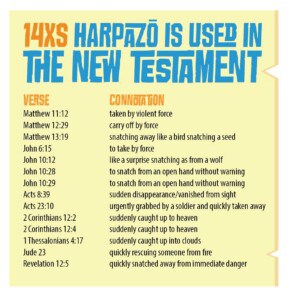
The argument proves too much. The word Trinity is not in the Bible. Neither is Great Commission. The word Bible is not in the Bible. What matters is whether the concept is there, and in the case of the rapture, the Greek word for it appears fourteen times in the New Testament.
So why rapture? When Jerome translated the Greek New Testament into Latin in the late fourth century, he rendered harpazo as rapturo. Jerome’s translation became the standard text of the Catholic Church for roughly 1,300 years, until the Reformation in the sixteenth century. When new English translations emerged, rapturo was carried over as rapture. The word is not in the Bible. The concept, harpazo, is there fourteen times.

Where the Bible describes it
Four passages carry most of the weight, and reading them together is the fastest way to get your footing.
- 1 Thessalonians 4:13-18 gives the sequence in the most detail: the Lord descends, the dead in Christ rise, living believers are caught up, and all of them are with the Lord from that moment forward. Paul closes the passage by telling the church to encourage one another with these words.
- 1 Corinthians 15:51-53 adds the physical dimension. Paul calls it a mystery, meaning something God had not previously revealed rather than something unknowable. One generation of believers will not experience death. They will be changed in a flash, in the twinkling of an eye. The Greek word behind that moment is atomos, from which we get the English word atom. It means an indivisible unit of time. The closest modern parallel is Planck time in theoretical physics, the shortest measurable unit of time, and God’s atomos may be shorter still.
- John 14:1-3 records Jesus telling His disciples that He is going to prepare a place for them and will come back to receive them to Himself. He is not only returning to them. He is also taking them to be where He is.
- Revelation 3:10 records the promise that the church will be kept from the hour of trial that is coming on the whole world. The preposition matters here, and it is one of the load-bearing verses in the timing discussion below.
The other uses of harpazo are worth scanning. It describes Philip vanishing from the roadside in Acts 8:39, a soldier being urgently pulled out of danger in Acts 23:10, and Paul being caught up to heaven in 2 Corinthians 12. In every case the action is sudden, physical, and initiated by someone else. That is the shape of the event Paul is describing.
The rapture and the second coming are two different events
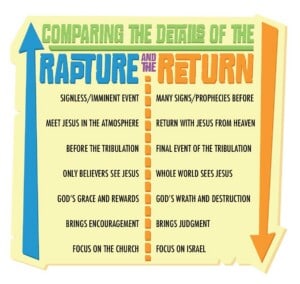
This is the question that clears up the most confusion the fastest. Both belong to the return of Christ, and Scripture describes them with different details and different destinations.
At the rapture, believers meet the Lord in the air and go to be with Him. At the glorious appearing described in Revelation 19, Christ returns to the earth itself, with the armies of heaven, and remains here to reign. Set Matthew 24:30-31 beside 1 Thessalonians 4:15-17 and the differences show up on the page without any interpretive help.
Todd’s illustration is the one most readers remember. The first coming of Christ had two aspects that we celebrate every year as Christmas and Easter, separated by roughly three decades. The second coming has two aspects as well: the catching away of the church, then the physical return of Jesus to the earth.
The four main views, presented fairly
Christians who take Scripture seriously land in four different places on the timing question. Only one can be correct, and none of them is a salvation issue. Study them, hold your conclusion with conviction, and hold your brothers and sisters with patience.
- Pretribulation. The rapture occurs before the seven-year tribulation period begins. The church is removed, then the antichrist confirms the covenant of Daniel 9:27, and the tribulation runs its course.
- Mid-tribulation. The rapture occurs at the midpoint of the seven years, at the moment the antichrist enters the temple and the mark of the beast is enforced.
- Pre-wrath. The seal judgments span the whole seven years, God’s wrath begins at the sixth seal, and believers are removed at that point rather than at the start (among some other pre-wrath views).
- Post-tribulation. Believers go through the entire tribulation and are caught up just before Christ returns to the earth.
For scale, the second coming is the second most prominent doctrine in the New Testament, with 321 references, behind only the doctrine of salvation. This is not a marginal subject in Scripture. Todd holds the pretribulation view, and the reasoning runs across ten lines of evidence in the book rather than a single proof text. The two that carry the most weight for most readers are the promise in Revelation 3:10 that the church is kept from the hour of trial, and the doctrine of imminency: the New Testament repeatedly tells believers to wait for God’s Son from heaven and never tells them to watch for the antichrist first.
There is also a pattern in the vocabulary of Revelation itself. The word church appears nineteen times in the first three chapters. Across chapters 6 through 19, the entire description of the judgments, the word does not appear at all, and the people who come to faith during that period are called saints (Revelation 13:7). It shows up one final time in chapter 22. Todd treats this as one strand of the cumulative case, and it is a pattern any reader can check with a concordance in a few minutes.
Was the rapture invented in the 1830s?
This objection comes up constantly, and it deserves a direct answer. The systematic, carefully organized version of pretribulationism does date to the nineteenth century. The underlying idea is far older than that. The early church believed it, and most importantly—Scripture supports it.
The Didache, the earliest known Christian doctrinal document outside the New Testament and generally dated to around AD 70 to 100, teaches that the Lord could return at any moment and that believers should always be ready. Irenaeus, writing Against Heresies around AD 180, described the church being suddenly caught up and then the tribulation beginning, in that order. Irenaeus was a disciple of Polycarp, who was a disciple of the apostle John. Ephraem the Syrian made a similar statement in the fourth century.
None of these writers produced a chart. They held the idea in a raw, unformalized state, the way the early church held many doctrines before controversy forced the church to define them precisely. Doctrine getting organized later is the normal pattern of church history, and it is not evidence that the doctrine was invented.
Why Todd wrote a book about the Rapture
With a resurgence of interest in eschatology, the enemy had a counterattack that, honestly, I didn’t see coming. I knew there were various views on the timing of the rapture within the church. I knew there were skeptics and scoffers from outside the church. What I didn’t see coming was an all-out attack on the doctrine of the rapture from within the church. Even worse, this attack was launched with straw-man arguments and outright false claims about the origin of the doctrine.
I also saw that those who do believe in the rapture didn’t seem to have a firm grasp on how it connected to the rest of the story. So I had a burden to assemble a comprehensive look at the topic from every angle: every rapture in the Bible, what the early church believed, what the most common arguments against the rapture are today, and how this amazing future event, which is literally called our blessed hope, fits into the story of the Bible and why it is so critical to understand it now.
I also wanted to present all of the main views of the rapture and my top ten reasons for believing the Bible clearly teaches the rapture will happen before a great time of testing that is coming upon the whole world at the end of the age.
How the illustrated approach helps
The rapture is a timing question, and timing questions are almost impossible to hold in your head as paragraphs. That is where the charts do work that prose cannot.
The Non-Prophet’s Guide to the Rapture puts all four timing views on a single timeline so you can see exactly where each one places the event relative to the seven years. It breaks 1 Thessalonians 4 down frame by frame, in order, so the sequence stops being a blur. And it charts every New Testament use of harpazo side by side so you can evaluate the word study yourself instead of taking someone’s word for it. Todd draws every one of these himself, which is why they read like a friend sketching on a napkin rather than a seminary handout.
The book built for this question
The Non-Prophet’s Guide to the Rapture is written for the person who wants to understand this doctrine without a seminary degree and without being talked down to. It works through seventeen chapters in five sections: the basics, the backstory of every other rapture recorded in Scripture, a frame-by-frame breakdown of the primary passage, what the doctrine means for how you live now, and how to be ready.
If you have picked up other end times books and put them down, the difference here is the artwork and the pacing. Todd illustrates the hard parts instead of describing them, and he does not assume you already know the vocabulary.
Teaching it in a group
The Resource Bundle is built for exactly that. It pairs a reproducible study guide covering all seventeen chapters with an illustration pack of the original artwork from the book. Each week supplies four to five discussion questions you can use as written or reshape to fit your room. Read through them a few days before you meet, pick a theme from the chapter to open with, and you are ready.
The guide also carries the ABC’s of Salvation, a simple outline you can hand to anyone in the group who wants to take that step. The illustration pack is the part leaders tend to notice: charts, timelines, and teaching visuals from the book, cleared for handouts, slides, or the screen in the room. The license covers small group or church use at a single location.
Leaders say the same thing about this topic: the hard part is not the teaching, it is the questions. The guide is built with that in mind. Every session opens with something anyone in the room can answer, and no session requires the leader to defend a position on the spot.
Resource Bundle: The Non-Prophet’s Guide to the Rapture
Related questions
- Is Bible prophecy actually reliable? Here is what you can check. → /is-bible-prophecy-reliable
- Is the Bible reliable? An honest look for people who are not sure. → /is-the-bible-reliable
Questions people ask about the rapture
What is the rapture, and is it really in the Bible?
The rapture is the moment when Jesus returns in the air and gathers living and deceased believers to Himself. The English word does not appear in Scripture, because it came into English through Jerome’s Latin translation of the Greek verb harpazo in 1 Thessalonians 4:17. The event itself is described directly in 1 Thessalonians 4, 1 Corinthians 15, and John 14.
What is the difference between the rapture and the second coming?
At the rapture, Jesus appears in the air and believers are caught up to meet Him. At the second coming described in Revelation 19, Jesus returns to the earth itself with the armies of heaven and stays to reign. Both belong to the return of Christ, and Scripture gives them different details and different destinations.
When will the rapture happen?
Scripture does not give a date, and everywhere the Lord’s return is mentioned, it is described as something that could happen at any moment (known as the doctrine of imminency). The debate among Christians is about where the rapture falls relative to the seven-year tribulation, and there are four main positions. Todd holds the pretribulation view and lays out the reasoning in detail rather than resting on a single verse.
Should I be afraid of the rapture?
Paul ends the primary rapture passage by telling the church to encourage one another with these words, and Titus 2:13 calls it the blessed hope. The doctrine was given as comfort. If it is producing dread instead, that is usually a sign the teaching you received was incomplete.
Was the pretribulation rapture invented in the 1830s?
The organized, systematic and academic version of the position does date to the nineteenth century (following the enlightenment period when this treatment was applied to all disciplines and relevant topics). The underlying idea appears far earlier, including in the Didache around AD 70 to 100 and in Irenaeus around AD 180. Doctrines commonly get formalized long after the church first held them. The most important question is: What does the Bible itself teach?
Do I need to read anything else first?
No. The Non-Prophet’s Guide to the Rapture starts with the fundamentals and does not assume prior study. If you want broader context on the end times timeline afterward, the Non-Prophet’s Guide to the Book of Daniel is the natural next step.
Where to go from here
Start with the book. If you are leading a group, the Resource Bundle gives you the seventeen-week study guide and the illustration pack together. Either way, you will come out the other side able to explain this doctrine in your own words, which is the whole point.