Bible prophecy for beginners: a no-intimidation starting point
You are not the problem
If you have ever sat through a prophecy sermon with the quiet feeling that everyone else got a handout you missed, you are not alone.
This subject has been taught badly to a lot of good people — through sensationalism, through charts nobody explained, through dates that came and went. The confusion that produced is not a character flaw. It is just a missing starting point, and a starting point is an easy thing to hand someone.
The short answer
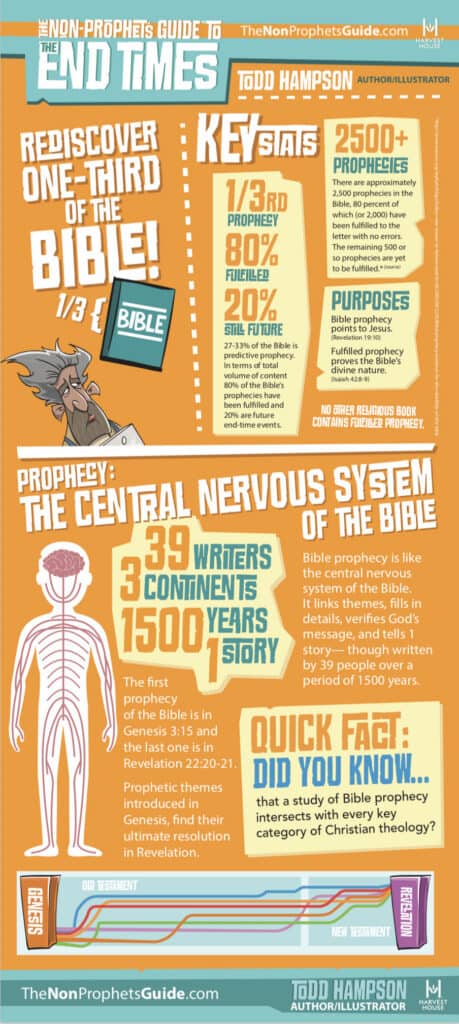
You do not need a seminary degree, overly-complex wall chart, or a settled opinion on every disputed detail to begin. Bible prophecy is simply the part of Scripture where God tells His people ahead of time what He intends to do — advanced intel for believers. About 28 percent of the Bible was prophecy when it was first given, and about 80 percent of that has already been fulfilled — which means most of what people call prophecy is now history you can go and check to verify its accuracy.
So start with what is already settled rather than what is still argued about. Learn the big picture before the fine print. The order that works for most beginners is the shape of the story first, then the end of the story, then the individual books that fill it in.
Why a quarter of the Bible scares people off
Three things have made a large, hopeful section of Scripture feel like a locked room.
The first is how most people met it. Not in a Bible, but in a divisive sensational YouTube video produced in a basement, someone force-fitting numbers and details by connecting dots that are not related, or a sermon that used the news to interpret Scripture rather than the other way around. Worse yet, many church leaders and teachers scoff at Bible prophecy, treating it as if it were about as important as whether Moses parted his hair on the right or left side of his head. When that is your introduction, the subject arrives pre-loaded with dread.
The second is volume. About 28 percent of the Bible is a lot of Bible. A reader who has decided the subject is beyond them has effectively decided that a quarter of Scripture is not for them, and that is a real loss — prophecy is woven through the whole thing. It is less a separate department than the central nervous system of the Bible, connected to every major area of theology.
The third is the fear of getting it wrong. Prophecy has a reputation for making people look foolish, and nobody wants to join that list. But the fear of being wrong about the details has kept an enormous number of believers from the parts that are not in dispute at all — which is most of it. The large puzzle pieces and basic chronology of end-time events can be clearly and confidently understood.
The five things beginners need to know first
It is about a Person before it is about a timeline. Revelation opens by calling itself the revelation of Jesus Christ, and says plainly that the testimony of Jesus is the spirit of prophecy (Revelation 19:10, NKJV). If a study of prophecy is not making Jesus clearer, something has gone sideways in the method.
Most of it has already happened. About 80 percent of biblical prophecy is fulfilled, and its fulfillment rate on everything past is 100 percent. The remaining 20 percent concerns end-times events. That ratio changes how you read: you are not being asked to trust a track record you cannot inspect.
It was always meant to be checkable. Fulfilled prophecy is the part a skeptic can test. Daniel predicted the timing of the Messiah’s arrival to a window a historian can date. Isaiah named Cyrus roughly 150 years before he was born, and the Cyrus Cylinder in the British Museum corroborates the decree. You can look these up. That is by God’s design.
You do not have to settle every disputed detail today. The large brush strokes — the basic puzzle pieces and the chronology of end-time events — can be known clearly and confidently. Below that level, sincere and serious Christians disagree about sequence and timing, and they agree on the things that matter most: Christ is returning bodily, God finishes what He started, evil does not get the last word.
Unity belongs around the fundamentals of the faith. But these are critically important details, not merely secondary opinions. Only one view of each key detail can finally be correct, and it is our job to consider the evidence carefully and prayerfully, with Scripture as the authority rather than a system, a tradition, or an opinion. A topic being secondary — meaning it does not affect your salvation — does not make it unimportant or vestigial. It is critically important on many levels. Every serious student of the Bible is on a journey of formulating and refining their theology. This is a life-long process.
The purpose is readiness and hope, not anxiety. The return of Christ comes up in roughly one of every thirty verses in the New Testament and in 23 of its 27 books, and more than fifty times Scripture tells readers to be ready. In almost every one of those passages the application is practical and immediate: walk in faith, resist temptation, confess quickly, stay awake, love people, live expectantly, keep working. Bible prophecy, properly taught, brings hope rather than fear.
How illustration makes prophecy learnable
There is a reason this material goes down easier with pictures, and it is not that readers are lazy.
Prophecy asks you to hold several things at once — a sequence of events, a set of symbols, a cast of characters, and a span of centuries. Prose makes you carry all of that in your head at the same time. A diagram sets it on the table in front of you.
Here is the way to picture the problem itself. We are stuck in time, floating downstream, able to see only the bend we are in. God sees time the way a helicopter pilot sees the river: able to move up and down its length, or gain altitude and take in the whole thing at once. Prophecy is God describing the river to people in the boat.
Once someone can see the shape of the thing, the details stop being threatening and start being interesting. That is the whole method.
Your first 30 days in Bible prophecy
Four weeks, about twenty minutes a day. No books required.
Week 1 — the whole story. Read Genesis 1–3 and Revelation 21–22 in the same sitting, then again at the end of the week. Everything between them is one story moving from a garden to a city, and seeing both ends first makes the middle legible.
Week 2 — what Jesus said. Read Matthew 24 straight through, in one sitting, before you read anything about Matthew 24. Most of us have only ever heard it in fragments chosen by someone making a point. Reading it whole changes the tone considerably.
Week 3 — prophecy you can check. Read Daniel 9 and Isaiah 44–45, then look up what historians say about Cyrus and about the dating of Daniel based on the discovery of the Dead Sea Scrolls. This is the week the subject stops feeling like a matter of opinion.
Week 4 — the end of the book. Read Revelation 1, then 19 through 22. Start at the end on purpose. Whatever you make of the middle, you should know where it is going, and it is going somewhere good.
After thirty days you will not be an expert. You will be something more useful: a reader who can tell solid teaching from the other kind.
It is the one to start with — the book that began the series, written for the person who has avoided this subject and would rather not be made to feel foolish for asking. It covers what Scripture says is coming, in order, in plain language, with illustrations and infographics the whole way through. It takes the subject seriously without taking itself too seriously.
If you would rather be pointed to the right first book for your particular situation — skeptic, intimidated believer, or group leader — start here instead.
Where should I start if I know nothing about Bible prophecy? Start with the big picture rather than a single book or event. Read Genesis 1–3 and Revelation 21–22 together to see both ends of the story, then read Matthew 24 straight through for what Jesus Himself said. For a first book, The Non-Prophet’s Guide to the End Times covers the whole landscape in plain language with illustrations throughout.
What order should I read the Non-Prophet’s Guide books in? It depends on where you are coming in. For the series as a whole, The Non-Prophet’s Guide to the End Times is the best starting point — it is the one that gives you the map everything else fits onto. After that, follow your own question and pick the guide that covers the book or topic you most want to understand.
Can a beginner really understand end-times prophecy? Yes, and more easily than most people expect. The material has a reputation for difficulty mainly because of how it is usually presented. About 80 percent of biblical prophecy is already fulfilled, so most of it is history you can read about rather than a puzzle you have to solve.
Do I need to read Daniel before Revelation? It helps a great deal. Daniel supplies the first clear prophetic timeline and introduces images and patterns that Revelation assumes you already know. You can read Revelation first, but Daniel is the book that unlocks much of what Revelation is referring to.
What is the easiest book on Bible prophecy to start with? An illustrated guide written for beginners will get you further than a commentary. The Non-Prophet’s Guide to the End Times was written specifically for readers who find the subject intimidating, and it uses charts, infographics and humor to carry ideas that are hard to hold in prose alone.
Should I be afraid of the end times? No. In His longest teaching on the subject, Jesus told His followers plainly not to be alarmed, and said that when these things begin they should lift up their heads (Luke 21:28). Teaching that leaves you anxious has gone wrong somewhere; prophecy taught faithfully produces steadiness and hope.
Contains information related to marketing campaigns of the user. These are shared with Google AdWords / Google Ads when the Google Ads and Google Analytics accounts are linked together.
90 days
__utma
ID used to identify users and sessions
2 years after last activity
__utmt
Used to monitor number of Google Analytics server requests
10 minutes
__utmb
Used to distinguish new sessions and visits. This cookie is set when the GA.js javascript library is loaded and there is no existing __utmb cookie. The cookie is updated every time data is sent to the Google Analytics server.
30 minutes after last activity
__utmc
Used only with old Urchin versions of Google Analytics and not with GA.js. Was used to distinguish between new sessions and visits at the end of a session.
End of session (browser)
__utmz
Contains information about the traffic source or campaign that directed user to the website. The cookie is set when the GA.js javascript is loaded and updated when data is sent to the Google Anaytics server
6 months after last activity
__utmv
Contains custom information set by the web developer via the _setCustomVar method in Google Analytics. This cookie is updated every time new data is sent to the Google Analytics server.
2 years after last activity
__utmx
Used to determine whether a user is included in an A / B or Multivariate test.
18 months
_ga
ID used to identify users
2 years
_gali
Used by Google Analytics to determine which links on a page are being clicked
30 seconds
_ga_
ID used to identify users
2 years
_gid
ID used to identify users for 24 hours after last activity
24 hours
_gat
Used to monitor number of Google Analytics server requests when using Google Tag Manager
1 minute
Marketing cookies are used to follow visitors to websites. The intention is to show ads that are relevant and engaging to the individual user.
Facebook Pixel is a web analytics service that tracks and reports website traffic.