

If you have quietly wondered whether the Bible is just the words of men, that is a fair question and a common one. Most people were handed what to believe long before anyone showed them why. The evidence for the why is public, it is checkable, and it is more accessible than most people expect.
The short answer
Yes, and the case rests on four things anyone can check. Scripture makes a large claim about itself, that it is God-breathed (2 Timothy 3:16), and it leaves that claim open to testing. The Bible describes the physical world accurately in places where the surrounding cultures had it wrong, centuries before instruments existed to settle the question. Its historical claims have repeatedly been called impossible and then confirmed by excavation. It survives in more than 67,000 ancient manuscripts, against roughly 1,800 for Homer’s Iliad, the next best attested work of the ancient world. And about 28 percent of it was prophecy when it was written, roughly 80 percent of which has already been fulfilled, with a 100 percent record on everything meant to happen by now.
Most people were taught what to believe, never why
Many of us who grew up around church were handed our beliefs the way we were handed a last name. Here is what we believe, but often without much explanation. We got the what. What people really need is to be shown the why.
That gap matters more than it sounds. Ken Ham and Jeff Kinley once commissioned a study, written up in Ready to Return, to find out when students walk away from the faith. The surprise was the timing. It was not college. By college it was just becoming visible. They were letting go back in middle school, and the reason was almost always the same: they had been taught what to believe and never why.
When your faith is not rooted in anything real, it slowly starts to feel like a childhood story you are expected to keep believing. A comfort. A Santa Claus for grown-ups. So let’s not only look at what to believe. Let’s take a closer look at the why.
What changed my mind about the Bible
I’m a Gen-Xer, and I grew up completely unchurched. I was convinced that evolution was true, that Jesus was not a real historical figure, and that the Bible was a book of fairy tales meant to answer hard questions in a pre-scientific age. I was not militant about any of it. That was simply where I had settled, as much as a young teenager could.
Then, as the Lord would have it, I wound up at a Christian camp for two weeks one summer, and at a Christian private school for three months the next year. The camp put biblical Christianity on my radar. The school started answering some of my questions. And the one thing that got my attention, the thing I could not explain away, was fulfilled Bible prophecy. It broke down the barriers to belief and made me actually consider the claims of the Bible, look into the historical evidence for Jesus and the resurrection, and take a real look at the creation account.
Four reasons the Bible holds up
So let me walk you through some of the same evidence that first got through to me. Here is the claim on the table. The Bible is one unified story: 40 authors, 66 books, written across roughly 1,500 years, on three continents, in three languages, and it holds together as a single account. It claims to be God-breathed (2 Timothy 3:16). That is a large claim. So why believe it? Four reasons.
-
The Bible is scientifically accurate
Long before the instruments existed to check, the Bible described the physical world correctly.
- Isaiah said the earth is a circle, a sphere (Isaiah 40:22), and Job said God hangs it on nothing (Job 26:7), while the cultures around them pictured a flat earth resting on animals or pillars.
- Jeremiah said the stars are too many to count (Jeremiah 33:22), at a time when Ptolemy had confidently catalogued exactly 1,022. Ask an astronomer today and you get Jeremiah’s answer.
- Leviticus located the life of the body in the blood (Leviticus 17:11), centuries before medicine understood circulation.
- Genesis 1:1 names time, force, energy, space, and matter in a single sentence, the five categories a 19th-century philosopher would later be credited with identifying.
The Bible was right all along.
-
The Bible is historically correct
Every time critics have caught the Bible in a supposed historical error, the ground eventually shifts under them.
- The Hittites appear 48 times in Scripture. For centuries there was no outside trace of them, so scholars called them a biblical invention, until 1834, when French archaeologist Charles Texier uncovered their capital at Hattusa.
- A worldwide flood shows up not only in Genesis but in more than 270 flood accounts across ancient cultures, including the Epic of Gilgamesh.
The pattern repeats: the Bible records something, the critics call it impossible, and eventually the evidence catches up.
-
The Bible is externally confirmed
You do not have to take the Bible’s word for the Bible. The outside evidence is overwhelming.
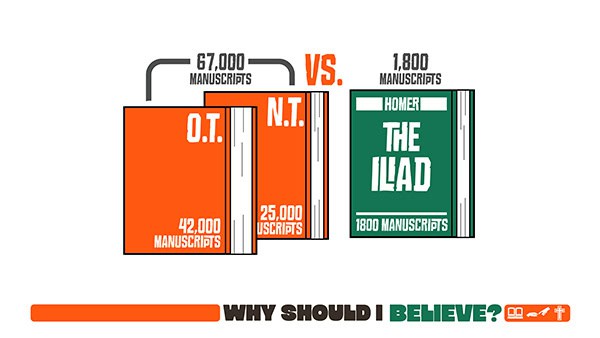
- The New Testament survives in more than 25,000 ancient manuscripts and the Old Testament in more than 42,000, over 67,000 in all. Homer’s Iliad, which no one doubts, survives in about 1,800.
- The Dead Sea Scrolls pushed our oldest Old Testament copies back a thousand years and showed the text had barely changed.
- Tacitus and Josephus, neither of them Christian, confirm the core events of Jesus’ life.
For example, this is the kind of evidence I lay out fully in the Apologetics Guide to Trusting the Bible.
-
The Bible is prophetically proven
This is the one that is hard to explain away. About 28 percent of the Bible was prophecy when it was written, and about 80 percent of it has already come true, with a 100 percent track record on everything meant to happen by now.
- 109 distinct prophecies described the Messiah before He came, and Jesus fulfilled every one.
- The rise and fall of named empires was written down in advance (Daniel 2, 7, and 11).
No other book in the world does this. The Bible was right all along.
And that track record is the whole point. When roughly 80 percent of the Bible’s prophecies have already come true, exactly as written, that is built-in proof of where this book came from. It tells us the Bible is from God, and that we can trust it on the things we cannot put under a microscope, including the most important one of all. God has shown us the way of salvation through Jesus Christ. We cannot prove that the way we can prove a fulfilled prophecy. But we can accept it, resting on a God whose track record has never once failed. That is what makes faith in Jesus a reasonable faith, and not a blind leap.
The Bible has outlived every attempt to destroy it
That same staying power is why this book has outlasted everyone who tried to bury it. In AD 303 the emperor Diocletian ordered every copy destroyed. Within a generation, the emperor Constantine commissioned fifty new ones at government expense. The skeptic Voltaire predicted the Bible would be gone within a hundred years; a hundred years after his death, the French Bible Society set up its headquarters in his old home in Paris and printed Bibles there to ship all over Europe. The most attacked book in history has outlived every one of its critics.
The Bible has been attacked, analyzed, and buried for two thousand years. It is still here, and on every point we can actually check, it is still right.
What this means for you
If you have quietly wondered whether the Bible is just the words of men, you do not have to settle that with faith or fear. The evidence is there to examine for yourself. If you lead a group, these four reasons give you solid ground the next time someone asks the hard question. And if you are equipping others, this is a frame you can hand them so your people are ready with reasons when the questions come.
How the illustrated approach helps
Evidence like this usually arrives as a wall of text, which is where most readers give up. Todd’s books draw the argument instead of only stating it. The manuscript comparison becomes one bar chart, 67,000 against 1,800, and the scale lands before you have read a word of explanation. The four reasons become one stacked frame a group leader can put on a screen. The argument does not get simplified. It gets drawn.
The book behind this teaching
Who it is for
Anyone who wants evidence before belief and would rather check the claims than be told to accept them. It also fits the reader who already believes and freezes when someone asks why, and the leader who needs something to hand a person with questions.
What problem it solves
The evidence for the Bible is usually scattered across a dozen books and written for people who already know the vocabulary. This puts manuscript evidence, archaeology, the Dead Sea Scrolls, fulfilled prophecy, and the resurrection in one place, in the order the questions actually arrive.
What makes it different
It is illustrated throughout. Charts, timelines, and illustrations carry the structure so the argument has somewhere to attach, which means a reader with no background can finish it and a leader can teach straight from it.
Get the book on Amazon · View it on toddhampson.com
Related questions
- Whether the Bible itself is reliable, answered in full
- Whether Bible prophecy holds up to checking
- Why Revelation feels so confusing
- Not sure where to begin? Start here.
Frequently asked questions
Is the Bible historically reliable?
Yes, by the same tests historians apply to any ancient document. It survives in more than 67,000 manuscripts against roughly 1,800 for the next best attested ancient work, the Dead Sea Scrolls pushed the oldest Old Testament copies back a thousand years and showed the text had barely changed, and claims critics once called invented, including the Hittite empire, have been confirmed by excavation.
Hasn’t the Bible been translated so many times that it has changed?
No. Modern translations work directly from the earliest manuscripts in Hebrew, Aramaic, and Greek rather than from earlier English versions. The Dead Sea Scrolls settled the question for the Old Testament by putting copies a thousand years older than anything previously known beside the text we already had.
Is Bible prophecy actually reliable, or is it interpretation after the fact?
Reliable, and the dating is what settles it. About 28 percent of the Bible was prophecy when it was written, roughly 80 percent has already been fulfilled, and the record on everything meant to happen by now is 100 percent. The manuscript evidence places the prophetic texts centuries before the events they describe.
What theological perspective do the books teach from?
A plain-sense reading of Scripture, which means taking the text in its normal sense unless it signals otherwise, and a conservative evangelical position on biblical authority. On prophecy Todd holds a pretribulational, premillennial view, and he says so plainly rather than presenting it as the only position anyone holds.
Where should I start if I know nothing about Bible prophecy?
Start with the evidence for the Bible itself, then move to the prophetic material. The Apologetics Guide to Trusting the Bible puts the foundation in place, and the Start Here page maps out what to read second and third depending on the question you came in with.
How do the illustrated guides differ from regular commentaries?
A commentary explains the text verse by verse and assumes you can hold the structure in your head. These guides draw the structure, so timelines and charts carry the framework and the explanation has somewhere to attach. That is why readers who have bounced off denser books tend to finish these.
Where to go from here
Trusting the Bible is the foundation everything else rests on. If you want the full case, that is what the Apologetics Guide to Trusting the Bible is for. You can find it on Amazon.
A version of this post first appeared in the Why Should I Believe? newsletter.
If any of this raised a question rather than answering one, that is a good sign, and it is exactly what this newsletter is for. New issues go out every other week, one clear question at a time.
Grateful you are here.
— Todd