

Almost everyone comes to Revelation with a decoder ring in hand.
I understand the instinct. The book is full of beasts and bowls and numbers, and the surrounding culture has spent a century treating it like a cipher laid over the evening news. So we open it the way you would open a locked box, looking for the combination — which symbol equals which country, which number equals which year.
And then we get tired, and we close it.
Here is what I have come to believe after years of drawing this book for a living: the decoder-ring approach is not just difficult, it is the wrong instrument. Revelation is not a code. It is a portrait. And once you read it as a portrait, most of the fog burns off. We can understand it from a plain-sense reading, and a working knowledge of the Old Testament.
Start with the title
The book tells you what it is in its first six words. “The revelation of Jesus Christ” (Revelation 1:1).
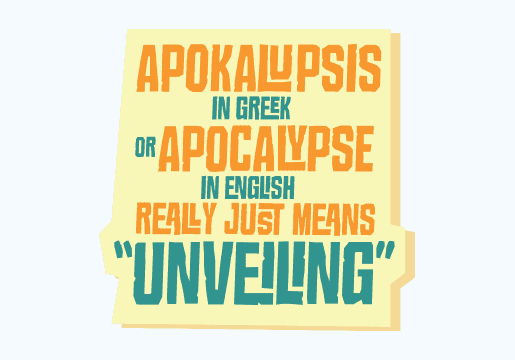
Not the revelation of the antichrist. Not the revelation of the tribulation timeline. The word translated “revelation” is apokalypsis — an unveiling, a pulling back of the curtain. The subject behind the curtain is a Person. It is both a revelation of the full picture of Jesus, and a revelation from the Savior Himself.
That is not a devotional softening of the book. It is the book’s own stated thesis, and later it says the same thing from another angle: “the testimony of Jesus is the spirit of prophecy” (Revelation 19:10, NKJV). Prophecy exists to point at Him.
So the first adjustment is simple. When you hit a passage you cannot parse, stop asking what does this decode to and start asking: what is the plain-sense reading of this showing me about Jesus? You will be right far more often, and you will finish the book.
The book is doing three things at once
The second adjustment is recognizing that Revelation shifts gears, and that each gear has its own rules.
It is a letter. Chapters 2 and 3 are correspondence to seven actual churches in seven actual cities, with the kind of problems you would recognize at any congregational meeting today — one church has lost its first love, another has gotten comfortable, another is hanging on under real pressure. These chapters need no chart at all. They need to be read the way you would read Paul writing to Corinth. That said, each of those letters closes with a prophetic statement that can be applied to the Church at large.
It is prophecy. The book claims to tell what is coming, and it stands in a long line of prophetic writing with a verifiable track record behind it. About 28 percent of the Bible was prophecy when it was given. Roughly 80 percent of that has already been fulfilled, with a 100 percent fulfillment rate on everything in the past. The remaining 20 percent is end-times material, which is most of what Revelation is handling. A book with that kind of record behind it has earned a careful reading. The book was written in AD 95 and looks forward from that point.
It is apocalyptic. This is the part that trips people, because we do not read anything else like it. Apocalyptic writing communicates in vivid pictures on purpose — the same visual register you find in Ezekiel’s wheels and Daniel’s beasts. The pictures are not a disguise. They are a delivery method, chosen because an image lands harder and lasts longer than a proposition.
Most of the confusion I encounter comes from someone applying letter-rules to a vision, or vision-rules to a letter. One caveat is that while this is apocalyptic writing, it is also God-breathed (2 Timothy 3:16). That is important to note, because some scholars put extra-biblical apocalyptic writing in the same category, and that is a dangerous move. We should view everything through the lens of Scripture. Viewing Scripture through the lens of secular writing leads to great error.
Symbols were never meant to hide anything
The deepest misunderstanding is that the symbols are there to conceal. They are not. They are there to show. Symbols point to concrete realities that we can understand from Scripture itself.
Watch the book interpret itself. In chapter one John sees seven stars and seven golden lampstands, and before the chapter closes, the text simply tells him what they are: the stars are the angels of the seven churches, and the lampstands are the churches (Revelation 1:20). No decoding required. The book volunteers it.
That pattern repeats. And where Revelation does not explain an image outright, Scripture usually has already. The Lamb who was slain is not a puzzle if you know the Passover. The tree of life is not a puzzle if you have read Genesis 2. Revelation is the last chapter of a story, and last chapters assume the earlier ones. Some scholars note up to 350 direct allusions to the Old Testament. The symbols always connect to somewhere in the Bible.
This is also why Daniel is so often the key that turns. Daniel supplies the framework and much of the imagery Revelation builds on, and in chapter 9 it lays out the first clear prophetic timeline in Scripture, pointing ahead to key events at the end. I have called Daniel the Rosetta Stone of Bible prophecy for this reason — read it first, and a surprising amount of Revelation stops being strange.
What you find when you stop decoding
Here is something that delights me every time.
Revelation 21 lists twelve foundation stones of the New Jerusalem. For most of history that was simply a beautiful list. But of all the precious jewels we know of, only sixteen are anisotropic — gems that refract pure light into every color rather than going dark under it. That distinction became discoverable only in roughly the last hundred years, with lasers and microscopes able to slice a gem thin enough to test it.
All twelve foundation stones named in Revelation are among the sixteen.
A man writing two thousand years ago on an island, with no instrument capable of detecting the difference, lists twelve stones that all happen to belong to a category science could not identify until our lifetime. That is not a code to crack. That is a detail you only notice when you stop treating the book as a riddle and start reading it as a description of something real.
How to actually read it this week
Four things, in order:
- Read Daniel first, or at least alongside. It is shorter than you think and it unlocks the imagery.
- Read Revelation straight through in one or two sittings, without stopping to resolve anything. You are getting the shape of the book, not solving it.
- Use a visual. A simple timeline or structural chart does in one glance what paragraphs do poorly: it shows you where the sequence is moving forward and where the camera has pulled back for the wider view.
- Ask the Jesus question at every hard passage. What is this showing me about Him? That question is almost always answerable, and it is the question the book was written to answer.
You will not come out of this with every detail settled. Nobody does, and anyone selling you certainty on every verse is selling something. What you will come out with is the thing most readers actually wanted: the book’s shape in your head, its hope in your chest, and the sense that the last chapter of Scripture is not a locked door after all.
Things are not falling apart. They are falling into place.
Read next:
Go deeper: The Non-Prophet’s Guide to the Book of Revelation walks the whole book in plain language with charts and illustrations throughout.
Frequently Asked Questions About the Book of Revelation
Q: Why is the Book of Revelation so confusing?
A: Three things make it hard. It draws constantly on Old Testament images without stopping to explain them, it blends three kinds of writing in one book, and most of us were taught to treat it as a code rather than as a portrait of Jesus. Readers who adjust those three expectations usually find the book far more approachable than they expected.
Q: Do I need to read Daniel before Revelation?
A: It is not required, but it helps as much as anything you could do. Daniel supplies much of the imagery and framework that Revelation builds on, and in chapter 9 it gives the first clear prophetic timeline in Scripture. That is why Todd calls it the Rosetta Stone of Bible prophecy. Reading Daniel first makes several of Revelation’s hardest passages recognizable.
Q: Are the symbols in Revelation meant to be decoded?
A: No. In apocalyptic writing, symbols communicate vividly rather than secretly. Revelation frequently explains its own images outright, and where it does not, the picture has usually been defined earlier in Scripture. Symbols point to concrete realities, and Scripture itself is what defines them.